Showing posts with label Letters. Show all posts

Saturday, December 1, 2012

MESOPOTAMIAN NIGHT AND ASSYRIAN ART MUSIC GLOBAL REVIVAL

"Dr. Eden Naby has been supporting and sponsoring the Mesopotamian Night project since its inception in 2007. The Mesopotamian Night project received $17,000 grant from Naby Frye Assyrian Fund for Culture for MN2012 project and without this grant the creation and production of Malek Rama: The Handsome Prince musical would not have been possible. For our 2013 project, Naby Frye Assyrian Fund for Culture has granted us a $10,000 grant. We wholeheartedly appreciate these generous contributions. We are hoping to attract more sponsors and supporters like her so we can continue to expand this important cultural and arts project." 

Dr. Eden Naby at Mesopotamian Night 2012 event in Mountain View, CA

Taking the lead in promoting Assyrian music for art and entertainment, Mesopotamian Night, under the energetic persistence of Tony Khoshaba is revving up to bring us the 2013 event that more and more people across the United States and Canada are awaiting. Keep June 15 on your calendar, bring family and friends, and let us make this annual event to gather family from the far corners of our diaspora.

But as much as I admire Tony’s efforts and the enormous coordination it takes in time and devotion from a family man with teenage children (and a patient and supportive wife) to do this work, I am as grateful for the Assyrians up and down the California coast who work cooperatively to promote this one night event.  With all the effort, it should certainly run for a week. And it should travel to other locations like Phoenix, Chicago, LA and Detroit to inspire all of us, in all corners of our North American diaspora as we mourn the loss of homeland, devoted parents who brought us up Assyrian, and the dispersion caused, ultimately, by genocide and the prejudices of our neighbors.


Now as we head to the end of another tax year, it is time to remind ourselves of the importance of retaining our culture, in all its diverse branches: history, music, art, poetry, performance. Our financial support can be demonstrated to this Mesopotamian Night effort by our presence at the event, by purchase of the DVDs and CDs of the music (not nearly as vivid as watching a cast of dozens perform Malik Rama Lakhuma last February 18 in San Jose), and through outright donations.


I urge you to join our tiny Naby Frye Assyrian Fund for Culture in sending your $1000 and up donations to this tax-exempt organization, the Assyrian Aid Society, specifying use for Mesopotamian Night.  Maybe if enough of us donate, we can persuade the AAS to forgo that interminable auction intermission.

And if the AAS, and that lovable man who makes even these auctions bearable, can pledge specific amounts to the promotion of culture on the Nineveh Plain, so much the better.
Eden Naby

Professor Richard Frye at the Mesopotamian Night 2012 event in Mountain View California -
We are so grateful for his participation and support. Thank you Malpana!

Thursday, May 20, 2010

Abboud Zeitoune Commentary on Mesopotamian Night


Mr. Abboud Zeitoune the sole expert on Assyrian discography recently sent us an article about Mesopotamian Night concert. We are glad our project has echoed beyond the boundaries of California and we are excited that Assyrian intellectuals and community activists are paying attention.


Introduction

As I was asked to write a review about the Mesopotamian Night Concerts, I firstly tried to find something similar or the same as this way of music performance. My second thought was “are there any negative points or aspects where the arranger should recognize in the future.”
The Assyrian music scene is generally lacking high quality music performance. Mostly Assyrian music is played at dance festivals or weddings. The rare number of exceptional events could not stop this development. Although today we have at least 500 singers. I’ll discuss the quality of modern Assyrian music later in this review.

There are a small number of outstanding musical events in modern Assyrian history, which we can declare as milestones in this field. There are only some concerts which took place which are memorable to public. Such an event was the UNESCO - Concert of the years 1973/1974 in Beirut. Although the possibilities regarding recording, acoustic and music were not comparable to the current standards this concert is still alive in at least two generations.
With the emigration of Assyrians in the last decades, several organizations and centers for music have been established. While Chicago counts as the east-Assyrian music capital, Sweden became the important place for west-Assyrian music productions.

In the last 30 years there were many musical projects organized. Most of the music productions are still music albums of single artists. In the same time the number of concerts is rare. In comparison to the US in Europe more concerts were arranged. Here I can mention the following (main concerts):

HA Bnissan Concert in Sweden 1989

Concert Unexpected Meeting in Sweden 1998, by the talented young musician Gabi Masso and Yaakob Danho

Ornina Concert 1999

Syriac Music Choir in Sweden (Issa Hobil)

Several choir concerts of the Mor Afrem Choir Wiesbaden (Dr. Abrohom Lahdo)

Several choir concerts of the Mor Ephrem Choir Enschede (Elias Musake)

Honour concerts for Habib Mousa (2009) and Shabo Bahe (2010) in Sweden

I am personally pleased to recognize the larger interest of the public in such events.

The Location

I am very aware of Assyrian musical projects. I was happy as I saw the advertisement of a concert in the US. This was the trailer for the Mesopotamian Night 2008. The first thing that took my attention was the location of the planned concert. This location (http://www.galloarts.org) was something impressive. This concert hall was a good choice to guarantee a concert atmosphere. In comparison this hall is more professional than I saw here in Europe. Most concerts I attended were hold in community halls or churches. In such buildings it’s always a problem to get the best acoustic and concert atmosphere.
The Program

In both concerts classical Assyrian music was main topic in the program. For this the arranger took pieces of masters like William Daniel or Paulus Khofri. For sure this kind of music is of high quality and there is no doubt that these works are masterpieces. I am trying to find some Assyrian origins in their music. As I am a west-Assyrian, who grew up in an oriental society I feel more comfortable with church or oriental tunes. The other thing is that all these masters studied in western countries and were influenced by classical European composers.


In comparison to this part I can mention the concert of Malfono Nuri Iskander, who is very known in Syria and their surroundings. In one concert in 2008 he created something new from old heritage. He shows that the roots of Arabic or oriental music have their roots in our church and so from ancient Assyria [see this clip1, or listen to this audio].

For the Mesopotamian Night series I wish that the arranger could present something similar from our ancient roots. I am not against the modernization of our music. But to develop our own Assyrian music and not to adapt other music styles. We have great pieces in the current style, but there are the Assyrian roots (beside the language) missing.

For the popular music part the choice of Ashur and Walter in MN was good. There is a lack in our music scene of concert artists. Most of our singers are Party entertainer where they can hide their mistakes behind loud keyboard machines. In a concert with a well organized orchestra it’s more difficult to make a good performance. Beside the above mentioned artists I think Linda George, Nagham Edwar Mousa or Ogin BetSamo are further artists who would be good on stage.

In general I missed the west-Assyrian part in the MN concerts. We have also great performer who could fill the stage. These singer show their talent in such events in several occasions as I mentioned above. Beside known singers like Habib Mousa, Ninib A. Lahdo or Sardanapal Asaad there are also younger talents who could take this challenge. There are also pioneers and masters in west Assyrians music like Gabriel Asaad who also deserved a tribute at one of the next concerts.

The Musicians

The variety of musicians and instruments impressed me too. Also the conductors were professionals who had the orchestra under their control. I am also happy to see that many of the musicians were Assyrians. In this context I remember a statement also by Nuri Iskander who was asked to arrange the first Assyrian song festival in Qamishly. He said I can’t work with wedding and party musicians. He said that these kind of performance is different than parties and asked the arranger to invest more money in this issue.


I compare also here the differences between west and east Assyrian music styles. The eastern part has three different schools in the recent past. In Iran the influence of European music imported by masters like William Daniel, Nebu Issabey or Paulus Khofri was large. In Iraq we can see two different developments. The schools of Hanna Patros or Jamil Bashir were oriental and used also instruments from the same area as Oud. The other development started in the Royal Air force station of Habbaniya. There our Assyrian people adapted the western style of music and their instruments. The oriental style and instruments dominate the west Assyrian music.

We have to consider that the whole oriental music have their roots in ancient Mesopotamia. Also mostly all instruments were known by our ancestors. I hope we could focus more in our old heritage and develop the music taking the preserved musical traditions from our churches. For most scholars there is no doubt, that ancient melodies were implemented in our church hymns. A good door to enter this treasure is the BethGazo of Saint Mor Afrem.

Conclusion

In the last years we have seen some good concerts which is a good sign for the development of our music. Especially the Mesopotamian Night Concerts have the potential to deliver one of the best performances of Assyrian music worldwide. The arranger should only consider the mix of eastern and western Assyrian parts and try to implement more Assyrian-oriental elements in the music. In my opinion MN concert/s were a good start to stimulate the interest of our people in listening and appreciating music of a higher standard and of different styles to what is the daily normal music of these days being presented at parties, weddings, on radios and/or TV channels.

One more important thing for the MN series is the donation for charity projects. So we can develop our culture (music) and help our needy people in Atra.

Finally we in Europe hear and see good musical development from USA. Of course the Assyrian Hollywood is Chicago with their singers but such a quality of performance was not well known until now.

I thank the AAS for this great project series and hope one day to attend one of these events.
I also thank my friends Romeo Hanna, Moneer Cherie (both from Sydney) and Hanibal Romanus (Sweden) for pre-reading this article and for their comments.

Personal request: For preserving our musical heritage I am collecting Assyrian vinyl records. It will be great if readers of this article could contact me for buying or exchanging such material. This material is needed for my next book on Assyrian music. Please contact me at Zeitoune@online.de.

Abboud Zeitoune
www.musicpearls.net

About Abboud Zeitoune


Abboud Zeitoune’s passion for the Assyrian music developed with the participation at the activities of the Assyrian Beth-Nahrin culture and sport association in Wiesbaden (Germany) and his long membership in the Assyrian Democratic Organization.

Until the year 1984 he attended the known “Taw Mim Simkat” school in Beirut. He studied the Syriac language till the 5th class (teacher at that time: Saliba Afram Nejme, now in Germany). This education was sponsored by Bishop George Saliba. Abboud participated also at some activities of the Assyrian association (“Al Jum’iya al-Thaqafiya”) there.

After his migration to Germany in 1984 he had the fortune to continue his school and was able to leave it with a degree in economics in 1996. Today Abboud works as internal Auditor for the known retailing company METRO.

From 1987 Abboud took part in regular activities, like festivals, lectures or meetings of the association in Wiesbaden. There he was responsible for several tasks (like leader of youth-, folklore- or university graduates group). Between 2000/2001 he was also elected as chairman of the whole association. Since 2008 he is again chairman of the Beth-Nahrin cultural Association in Wiesbaden

Already in 1991 Abboud Zeitoune became a member the ADO which at that time were operating in secret. Through his membership in the ADO he participated and organized supraregional activities like youth camps.

In the ADO he became responsible for German Section in 1997 - 2003. During this period he gave many lectures (e.g. at the I. “Suryoye L-Suryoye” symposium in Heidelberg). From 2003 till May 2007 he was responsible for the European mediadepartment of the ADO (especially the website ado-world.org).

In the field of journalism he worked and wrote for several newspapers and magazines:

German editor of the “Shrogo”, the magazin of the association in Wiesbaden (1993 - 1995 and 1999-2000)

German editor of “Shemsho”, the magazine of the assyrian federation in Holland (1992 - 1993)

Author of several articles in FUNOYO, the new european-assyrian magazine since end of 2005.

He has been married since 1997 to Wafa Shamoun and has three children (Tuma, Sibora and Lebaryo).

His book “Music Pearls of Beth-Nahrin - An Assyrian/Syriac Discography” is the first attempt to document and archive our modern Assyrian music.
Thursday, March 4, 2010

AAS-A BOD Dinner Fundraiser: An Evening to Remember


By: Elki Issa

The Board of Directors of the Assyrian Aid Society convenes annually in one of its chapter cities for a weekend of meetings, capped off with a fund-raising dinner. This year’s event was hosted by the AAS’ Central Valley Chapter and was held at the beautiful Season’s Catering in Modesto on Saturday, February 27th.

Over 100 of our loyal supporters attended this year’s dinner and enjoyed a wonderful evening of good food and superb wine while listening to the folklore music of the legendary Sooren as performed by local musicians.

The evening began with a welcome from AAS President Narsai David. After giving the audience an overview of the financial status of the AAS, Narsai introduced the first of only a limited number of reproduced flag prints that belonged to Agha Petros. Four generous supporters bought one each which raised $4400 for AAS, leaving the AAS 16 prints to be auctioned off at future events.

We were fortunate to have with us this evening the legendary artist, Rabi Hanibal Alkhas. Rabi Hanibal gave a lovely speech, providing some great commentary on current Assyrian politics.

The highlight of the evening was the tribute to Sooren Alexander. The granddaughters of the late composer provided us with a biography of the legendary musician, and it was truly amazing to hear of the many achievements of this talented Assyrian artist. Sooren produced some of the most beloved Assyrian folkloric classics, five of which were performed for us that evening.

The Central Valley Chapter of the AAS is to be commended for hosting such a beautiful evening. The chapter’s volunteers - Tony Khoshaba (also the newly elected Director to the Board), Fred Isaac, Bata Younan, Sargon Alkurge, Rita Mulhim and Gina Shamoon and Kooroosh Hormozi - all worked tirelessly. Job well done!

Thursday, February 4, 2010

Assyrian Writer Comments on Assyryt DVD

The Assyrian Writer, George Yana, who has published a book titled "Ancient and Modern Assyrians" recently sent us the following encouraging comments about our Mesopotamian Night 2009 project that we would like to share with the readers of this blog.


"
The music of Paulus Khofri is beautiful, and I consider it one of the main attractions of this concert. Loraine Davis is amazing and the audience loves her.

But, Samuel Khangaldi stands out; his overture to the Oratorio of Gilgamesh is a gem.

I had never heard his name (Khangaldi), and now we are facing a new William Daniel , or shall I say, an Assyrian Khachaturian or Alan Hovhaness .

I think the Assyrian community, that is Mr. Tony Khoshaba , Mr. Obelit Yadgar , Mr. Narsai David and others, should see to it that this overture to the Oratorio of Gilgamesh is played by world class orchestras, such as the San Francisco Symphony, the New York Philharmonic, the Philadelphia Orchestra, etc, depending on where we can be successful. Once this is accomplished, the radio stations will begin to broadcast it, and, hopefully, the rest of the world will catch up with it.

This piece of music, in addition to being beautiful and oriental, has a certain mystical character that befits its title.

When I first played it, Marie-Therese , my wife, who is hard to impress, came in and asked “whose is this?” I am mentioning this because her ear, like mine, is used to hearing classical masterpieces.

Congratulations, you have provided a stage for our talents to flourish, and I hope that this beautiful beginning will continue its ascending course.

Wishing you more success,

George Yana (Bebla)

"

Tuesday, January 19, 2010

Michel Bosc to Compose the Music for Shamiram-Ninos

It is a pleasure to announce that Michel Bosc the composer of the Qateeni Opera which was performed in Mesopotamian Night 2009, has taken on the composition of music for Rabi Yosip Bet Yosip's Shamiram-Ninos poetry piece. This piece which Michel calls "Heroic Pastoral" is expected to be performed in Mesopotamian Night 2010 concert. In his recent email Michel Bosc writes:


"The first step composing the music for Ninos and Shamiram is to imagine both of them as characters and vocal colours. Ninos must be a tenor, heroic and elegant ; Shamiram is a brilliant and sensual high soprano coloratura. Then, you have to cut the text into different parts, to plan recitatives, arias and duets, and build all the text as a true music piece. It’s a Pastorale. French baroque music was rich in this kind of piece for voices and instruments. The orchestra must take its place too. Shamiram’s orchestral colours are harp, celesta, strings and winds ; prince Ninos has brasses and deeper colours. I plan a brilliant virtuoso piece for Shamiram when she evocates the dove flying ; a “vocal firework” for coloratura soprano, I guess it could become the highlight piece of the Pastorale. It’s a real change after the epic Qateeni opera first act, with masculine colours."

Sunday, January 10, 2010

An Appeal for Sponsorship of 2010 Mesopotamian Night Concert

Dear friends and sponsors of The Mesopotamian Night musical fund raiser

Mesopotamian Night project now is in its fourth year of operation. We have produced so far three important Assyrian cultural events. These events not only made significant contributions to the production, documentation and revival of Assyrian music in various forms (classical, opera, folklore and pop music) and promotion of Assyrian visual arts, but also raised over $165,000 in the span of three years for the humanitarian and cultural projects of Assyrian Aid Society of America. This an unprecedented success story and it has only been possible by hard work of our committee members, passionate contribution of our artists, and the generous support of our sponsors like yourself.

Like last year, in this letter of appeal, I am going to give you a short progress report on the Mesopotamian Night project. I am hoping I can count on you again to remain our sponsor for 2010 concert which will be held in Modesto, California in Summer 2010.

1. Despite all the economic difficulties of 2009, Mesopotamian Night 2009 raised $35,000 for AAS-A general funds to be used directly on Education projects in Bet-Nahrin, Iraq.

2. We funded and completed two Assyrian folklore classical symphonic suites based on the composition works of the Assyrian composer Paulos Khofri. Suite No. 1 was performed and Suite No.2 to be performed in 2010.

3. We helped form a new choir group called “Mesopotamian Choir Ensemble”. This group performed three choir songs from Rabi Paulos Khofri and Rabi Nebu Issabey. These choir songs for the first time were performed with a fifty three piece symphony orchestra.

4. We added two more songs to our collection of William Daniel classical folklore music which were performed by Assyrian soprano Lorraine Davis.

5. We successfully kicked off the creation of the opera Qateeni and successfully premiered one act of this opera reviving the already forgotten epic poem master piece of William Daniel.

6. We continued work on the Assyrian opera Gilgamesh and premiered another scene from this opera.

7. By our support for the first time an Assyrian classical composer (Rev. Samuel Khangaldy) started the creation of a magnificent piece of Assyrian classical music called “Gilgamesh Oratorio”. The overture for this work was successfully performed in 2009.

8. For the first time in addition to attracting support from community resources (individuals and organizations), we managed to attract funding in the form of a two year grant from The James Irvine Foundation a well respected California based organization that supports creation of works of art, music and education by those organizations that make significant contribution to the life of people of California.

9. We managed to produce yet another DVD/CD product from our 2009 project which will help propagate the project throughout the world and enrich the artistic content of Assyrian TV and radio channels worldwide. This time we managed to attract the department of film and TV production of the Modesto Junior College to help us with this ambitious undertaking.

10. We continued working with our pop singers to bring better quality performances to the community. In 2009 Lida Lawando and Emanouel Bet Younan had the opportunity to represent the Assyrian pop music to our audience. Our project commissioned the orchestration and arrangement of their songs for a larger orchestra.

For the Mesopotamian Night 2010 project we have already planned an ambitious set of goals:


1. The string quartets of William Daniel have already been given to Assyrian musician Sam Madoo to be prepared for performance.

2. The music compositions of late Alexander Sooren (a total of sixteen pieces) which were initially documented and scored by Assurhadoun Khofri have been commissioned to another musician for orchestration and score preparation.

3. A new project is initiated for the creation of an Assyrian operetta based on the folkloric tales of Shamiram and Ninous documented by Rabi Yosip Bet Yosip as a poetry piece.

4. More Assyrian classical composers have joined the Mesopotamian Night project. In 2010 two new young composers will be introduced to our community. The Mesopotamian Night project already has motivated more Assyrian talents to produce new works of music as they see an opportunity for their work to be premiered.

5. We will continue the completion of two operas (Gilgamesh and Qateeni) and the Gilgamesh Oratorio hoping that at some point in future we would be able to produce full Assyrian operas.

6. We will add more to the collection of our choir songs. Two important works of Nebu Issabey including the historical “Mar Benyamin Shamon Oratorio” will be orchestrated and performed in 2010.

7. We will continue to produce more quality pop music by our renowned pop singers. This year we plan to mesmerize our audience with songs from 70s and 80s with new instrumental arrangements.


Without contribution of our sponsors we cannot complete the above projects. It is critical that in the next three months we raise enough funds to complete all the composition and arrangement works. I am confident I can again count on your support and sponsorship.

If you have any question you could contact me by my email tonykhoshaba@sbcglobal.net or my cell phone 209-606-5438. The donations could be sent to AAS-A Central Valley Chapter P. O. Box. 579843, Modesto, CA 95357. Please write in memo “MN2010 Sponsor”.


Sincerely,


Tony Khoshaba
Assyrian Aid Society of America - Central Valley Chapter President

Tuesday, August 18, 2009

Comments about Mesopotamian Night 2009


Narsai David, President of AAS-A:

"I want to congratulate you on the fine production Saturday night in Modesto. Like so many in the audience said afterward, it was simply stunning to hear opera in Assyrian, a truly memorable moment for all Assyrians who hear it. And the oratorio, I cannot express to you what a thrill it was to hear. I cannot wait to hear it again on a disk. Congratulations, you should be very proud of the Mesopotamian Nights success. Many many thanks for all of your hard work as well as that of the chapter volunteers. Bravo!"

Sam Madoo, An Assyrian musician from LA:

I can't tell you how much I loved the first half of the program. The music composed by Michel was spectacular. The orchestration and harmony was just breath taking...

Hilda Kanon, from San Jose:

I am sure I am not the first one or the last to offer you Congratulations and Thank you on a job well done. It was again an amazing evening! We especially enjoyed the symphonic part in the first half. The compositions were so warm and inviting...so full of eastern warmth and harmony. The second half was very moving as well ... I am full of hope that your vision and actions will help awaken this nation to recognize it's artist and preserve it's culture and identity.

You make us start anticipating what's for next year !! We are proud of you and proud to call you Aakhonna b Oomtaa.


Helen Talia, from Chicago:

It was a pleasure taking a part in a big event ~ "The Enchanted Mesopotamian Night". I am still talking to people about it. I appreciate everything, more than I can express in words.

Maryam Pirayou:

I would like to thank you and all those who were involved in the production of this wonderful event. It takes a lot of time, energy, and hard work. Great job and thank you.

Christine Faulkner:

The event was amazing, and you all should be very proud of pulling off such an event.

Dr. Alex Malik, from Sacramento:

Congratulations to the Central Valley Chapter. The event was truly a success. You guys really did a great job. The AAS now has 3 annual events that will continue to set the bar higher and higher for all other Assyrian events. Great job!

Dr. Vian Yonan:

Congratulations on the third annual Mesopotamian Night, it was quite memorable ...

Mona Malik, from San Francisco:

I truly enjoyed the evening, specially the first segment before the intermission. The Gilgamesh Oratorio music was beautiful, the Mesopotamian Choir were great and the orchestra as a whole were fantastic ...

Peter Bityou, from Chicago:

Congratulations to Tony; Fred and entire Central Valley chapter members for their dedication and hard work, which made the Mesopotamian Night 2009 event an exceptionally successful one. Your hard work, commitment and resilient contributed to the success of the event ...

Robert Mulhim, from Chicago:

I add my voice to the rest of the AAS BOD family and congratulate you guys on a job well done! Please pass along our sincere appreciation to all those who worked so hard in making such an event successful including what we refer to as the 'Unknown Soldiers' who normally work behind the scenes.

Ninva Yonan, from LA:

My family and I had a great time. It was so entertaining that both of my children (4years, 11 years), were quiet and entertained for the entire evening. Thank you all for such a memorable cultural evening. We were so glad to be part of it.

John Anderson:

...We had a wonderful evening at the Gallo Center. The entertainment was out of this world. Neither one of us would have missed it for the world. Thanks so much for insisting we participate in such a worldly event. Again thanks so much for hospitality ...

Helen Talia, from Chicago:

"Nothing failed to remind us of the legacy of "Qateeni Gabbara" that the late William Daniel has left behind. An original production, hosted by the Assyrian Aid Society ~ Central Valley Chapter, was presented in an Opera and backed by ...an Orchestra. Yet nothing prepared the audience on the evening of the Mesopotamian Night for the five audacious performers who annunciated every word in the Assyrian language. If rocks could cry, they did on the evening of August 15th in Modesto. . . not a single person was not moved ~ either shedding tears, shifting back and forth in their seats, or clearing their throats."

Irene Bet-Daniel, from Virginia:

I am writing to you to show my admiration and respect for your devotion to the Assyrian Aid. May God bless you and all those who are working with you for this noble cause.

Thursday, August 13, 2009

Rabi Polous Khofri and the Youth Choir

We received the following article from Dr. Dennis Gelyana. Dr. Gelyana has been a sponsor and supporter of the Mesopotamian Night project in 2008 and 2009. This article is timely as we have only one day to MN2009 concert and that we have revived a glimpse of Rabi Paulus Khofri Choir group with the creation of Mesopotamian Choir Ensemble. This new choir group will perform two Rabi Khofri's songs (Nation Sacrifices and Vacant Nineveh) with the orchestra as well as the Nation song by Rabi Nebu Issabey.

My name is Dennis Gelyana. I had the privilege of being a member of the Assyrian National and Cultural Youth Center (Qhendroun) Choir in 1980s. The Choir was formed by the center’s Fine Arts Committee. The committee requested Rabi Polous Khofri, a distinguished Assyrian musician who conducted the Assyrian-Chaldean Catholic Church of Tehran’s choir, to create and conduct a national Youth Choir. I remember very well the very first meeting, his magnificent optimism, and his interesting and unique way of encouraging the members to learn and spread their musical heritage.

Rabi Khofri was making the practice sessions so appealing that every single member couldn’t wait for another weekly session of practice/class. His home was also always open for the members to see him with any questions, concerns, or comments.

I would like to mention that at that time there were several political/religious/cultural groups among Assyrians in the country that were not getting along with each other. At such a time, he composed a song for the commemoration of the 50th year after the massacre of Simele, in which he declared to all the groups, “the mother nation will not stop crying unless you accept every single one of your people (with different beliefs and ideas) as your brother. (EIMAN KHOOYEDLOUKH BE KOULE BNE OMTOUKH, HEGAH BED BARZI DAMAAD YEMOUKH.)” The same theme and music seems to be completely fitting for the story of our nation at this very moment.

Another event that must be mentioned was a performance in February 1988. At that year, the Office of Religious Minorities arranged a night for the minorities ( Zorasteans, Jewish, Armenians, and Assyrians) to honor the anniversary of the Islamic Revolution in the main performing arts center of the country, with each displaying their ethnic music. In short, our choir had the least members (13) compared to some choirs that had more than 50 singers. Likewise, our attire was very simple and not even comparable to other minorities. Before the show the members were somewhat discouraged, but Rabi Khofri, with his extraordinary kindness and encouraging voice of wisdom, made us very confident prior to our turn. In the end, our performance was at a much higher level than that of any other minority group; none of the other choirs could compete with it. I remember that backstage the conductor of the Armenian Choir told us that Rabi Khofri was one of his music teachers in Abadan, and the conductor of the Jewish Choir came to Rabi Khofri and asked him to have a performance in their cultural center. The next day the only photograph of the ceremony in the newspaper showed our choir; the only song from the ceremony that got broadcast on national radio was our song, composed by Rabi Khofri and performed by his choir.

Rabi Polous Khofri’s legacy will live on in the hearts of all those whose lives had been touched by him. He will remain a shining star in the history of our art and music for ever and ever!

About Dennis Gelyana, MD, MPH

Dennis was born in Abadan and raised in Tehran, Iran. He is a graduate of Alborz High School and Tehran University Medical School. After graduation he worked as a general practitioner in various settings in Mahshahr and Tehran. In 1995 he along with his wife Valantine, and his daughter, Eilrayna immigrated to the United States of America. He got his Masters degree in Public Health in Community Health Sciences from University of California, Los Angeles (UCLA); and finished his residency in Psychiatry at Rosalind Franklin University of Medicine and Science in Illinois. During his residency he got several awards including being elected to membership at Alpha Omega Alpha Honor Medical Society. He currently is a faculty member at the University of Chicago, Pritzker School of Medicine as well as being in private practice as a board certified psychiatrist in Illinois.

Dennis was an active member of Assyrian Evangelical Church Youth group during his high school years in Tehran, Iran. After the Islamic revolution he was selected by the Assyrian Tehran Association (Moutwa) to be a founding member of the Assyrian National and Cultural Youth Center (Qhendroun). That Youth center during 80s and 90s turned to be one of the most prominent groups that brought together younger Assyrians from different backgrounds to learn from experts and scholars of the community about their literature, culture, art, and history. The center helped the youth to believe in their potential and in the power of their unity. The outcome was outstanding activities, some at incredible high levels with endorsements from many organizations and churches. Dennis after Immigration to the United States has been active as youth counselor in different local Assyrian Churches in California and Illinois.

Monday, August 10, 2009

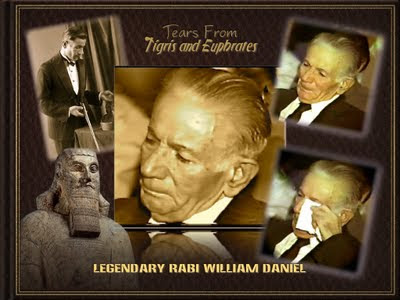
Tears from Tigris and Euphrates

The legendary singer and song writer Ashur Bet Sargis sent us this beautiful poster that we would like to share it with you. Let's reflect some more on the tears of late mentor and teacher Rabi William Daniel.

Sunday, August 2, 2009

Victor Davoody supports Mesopotamian Night 2009

Victor Davoody once again has surprised us with his honest devotion to Assyrian culture and arts and his unconditional and unselfish support for the Assyrian Aid Society. Mesopotamian Night team wholeheartedly says thank you Victor!

Here is Victor's message in his own words:

Our culture won’t be promoted by any people except ourselves! We need to support the people who are devoting their time for Assyria!

Please support Assyrian Aid Society; what they are doing today, will affect our future! Please support them if you even won’t have time to make it to Modesto on August 15!

Remember you are supporting our culture which enemies hoping to see it fade away!

Victor Davoody

Monday, July 13, 2009

A Message from AAS-A President Narsai M. David

Mesopotamian Night has now become a summer tradition in Modesto, and what a tradition it is!

For the third consecutive year Tony Khoshaba and the AAS-A Central Valley Chapter team have designed an extraordinary evening of both high culture and popular culture celebrating our wonderful and rich Assyrian heritage. The range of performers and talents involved at every level is staggering. If the previous two Mesopotamian Nights are any indication, hold onto your seats and prepare to be amazed.

At the same time, however, please keep in mind how important the money raised through events like this is for our education projects in the Homeland. The beginning of the new school year for our Assyrian schools in northern Iraq is only weeks away yet already we are learning of looming budget deficits and lagging financial support from the local and national governments. Without your help, without the funds raised by events such as this, the Assyrian schools we have all worked so hard to build and maintain over the past decade will be in jeopardy. Education is crucial to the future of Assyrians in our Homeland and to the continued flowering of Assyrian culture.

Narsai M. David

President, Assyrian Aid Society of America

Monday, April 27, 2009

WE WILL HELP UNTIL IT HURTS

By: Nineveh Babella Nissan

“We Are Assyrian,” a documentary produced by the prominent filmmaker Victor Davoody, was a spectacular premiere for our beloved community in the Central Valley. They gathered to experience this documentary for the very first time in the State Theater in Modesto, California on April 5, 2009. With the extraordinary efforts of Hollywood Connections Center and the Assyrian Aid Society-Central Valley Chapter, Victor Davoody was able to produce and create a remarkable documentary of the unforgettable Mesopotamian Night- Melodies from the East. The documentary portrayed the Mesopotamian Night in an artistic and exuberant way of presenting our musicians like never seen before.

As narrator of the film, Christen Cowden takes us on a journey beginning with a brief history of the Assyrians, indigenous people of Mesopotamia. She proudly states the achievements, inventions, language, and the history of the Assyrian people bringing us to who we are today and what great accomplishments we are struggling to reach as one nation. With honor and dignity, Cowden presents “The Mesopotamian Night” as one of our accomplishments and introduces the leaders, musicians, artists, and supporters of this great production to the audience. The interviews with the community members exemplified the level of intensity and excitement the supporters felt that night. They were anxiously awaiting the night to begin, to hear and see two phenomenal singers of our nation, Ashur Bet-Sargis and Walter Aziz, with an astounding orchestra and the Assyrian Classical Music and Opera. One of the most essential aspects of the film was listening to those who brought “The Mesopotamian Night” to life; the Maestro/Conductor, Assurhadoun Khofri, the music director and producer, Pierre Noghli, the President of the AAS Central Valley Chapter, Tony Khoshaba, the two famous Assyrian singers, Ashur Bet-Sargis and Walter Aziz, including the musicians and the dedicated members of the Assyrian Aid Society. It is through this documentary that the audience experienced the vision and intent of all those who struggled to create a masterpiece for the Assyrian nation- a night with melodies from the East for the very first time in Assyrian history.

The personal testimonies and reminiscences of all those involved in the making of the concert led to one goal; we want to unite and work for our people in our Homeland. Listening to the singers’ all-time favorite songs with the enchanting music playing in the background made the cause of the concert transparent in the musicians’ hearts and listeners’ souls. Ashur Bet-Sargis, our nation’s legendary singer, quoted Mother Teresa stating, “We will help until it hurts.” He presented the essence of the concert and assured the people that they should donate their time and money to this noble cause. With these powerful statements, Ashur emphasized that unconditional love for our nation will break all the barriers that are creating divisions and allow us to help our people no matter what it takes.

Davoody’s production of the concert presented our brilliant musicians and talented individuals who shared their contributions to this project. He captured the musicians’ and supporters’ personal reflections of the concert. Their reflections brought tears to our eyes because they wholeheartedly expressed how our singers and their lifelong struggle of keeping the Assyrian heritage alive have paid off at the end of the night. In the midst of the tough times our nation is facing, the AAS was successful in hosting the Mesopotamian Night and the outcome was rewarding. Most importantly, the community is grateful to Victor Davoody, who created a documentary for this production. Davoody’s goal was to give hope to our people that our culture will remain strong despite the differences in our nation and he emphasized that we need to work as one nation to help our people in Beth-Nahrain, our Homeland. Every time we watch the concert film, it will bring us back to the people, the singers, the musicians, and the goal of the Mesopotamian Night- we will relive that night once again!

Thursday, April 23, 2009

An Appeal for Sponsorship of 2009 Mesopotamian Night Concert

Dear friends and sponsors of The Mesopotamian Night musical fund raiser

In this letter I am going to give you a short report on our recent progress on the Mesopotamian Night project that started three years ago. I am hoping I will be able to convince you to remain or be our sponsor for 2009 concert which will be held in Modesto, California on August 15, 2009 at the Gallo Center for the Arts.

Mesopotamian Night 2008 had quite a few fruitful results. Our fund raiser contributed over $60,000 to general funds of the Assyrian Aid Society of America (AAS-A). AAS-A spend more than $750,000 on Assyrian Chaldean causes in 2008. Our Central Valley Chapter was part of this success story. We managed to premier excerpts from the first Assyrian Opera Gilgamesh (a work in progress pending on availability of funding) . We managed to orchestrate and revive classical Assyrian folklore songs already forgotten by our people among them four William Daniel songs. We also managed to perform the Assyrian National Anthem “Roomrama” in its orchestrated form not heard before. We demonstrated that combing Mesopotamian inspired art forms and music and western art forms and music is possible and produces fruitful results. One example was the beautiful ballet interpretation of the Mesopotamian myth of the Hullupu Tree. We demonstrated that our pop music has more potential and can go beyond our regular performances at parties and weddings. We managed to produce a DVD and a CD product from our 2008 concert with a quality that is unprecedented in our community thanks to talented Assyrian artists who were inspired to help us achieve this goal. We created a project that many experts in our community and outside our community cooperated to create an unforgettable event. This included musicians, film makers, composers, singers, performing art organizations, etc. This spirit of team work was by itself a major milestone and great experience moving forward.

For the Mesopotamian Night 2009 project we plan to bring in a 50-piece orchestra that would perform the following pieces: Assyryt: Symphonic Suite Assyria - We have funded and completed the creation of two symphonic suites based on the composition works of the Assyrian composer Paulos Khofri. Assyryt will be a major part of MN-2009 concert. The Opera Qateeni: This project which was started two years ago finally has come to fruition. Thanks to the dedication and hard work of a French composer that we were able to inspire to take on this important project. This opera is based on the three volume epic poem Qateeni Gabbara by Rabi William Daniel. We will present one full act of the opera based on chapter seven of the epic: In Malik Tooma's castle. The Overture from the Gilgamesh Oratorio: This is a new project initiated by Rev. Samuel Khangaldy of San Jose CA. The Death of Enkidu Opera Scene from the Gilgamesh Assyrian Opera: This is the continuation of the work on Gilgamesh Opera by John Craton based of Rabi Adddai Alkhas's Assyrian Aramaic version. More Assyrian folklore, classical and popular songs: We are again bringing an interesting array of Assyrian singers to perform at our concert using the 50-piece orchestra. Currently the challenge for the production of our 2009 Mesopotamian Night concert is attracting more funds for the orchestra and other production costs.

We would like to ask you to participate in the success of our project by being an sponsor for our project. While all sponsors will be recognized and mentioned in our program book, we have offered honorary membership in our organizing committee for all sponsors who donate $2500 or more. I appeal to you to join us this year to push the Assyrian art and music one step further. If you have any question you could contact me by my email tonykhoshaba@sbcglobal.net or my cell phone 209-606-5438. The donations could be sent to AAS-A Central Valley Chapter, P. O. Box. 579843, Modesto, CA 95357. Please write in memo “Mesopotamian Night 2009 Sponsor”.

Sincerely,


Tony Khoshaba

Assyrian Aid Society - Central Valley Chapter President
Mobile: 209-606-5438
Home: 209-579-2740
AAS-A Chapter mailing address: P.O. Box 579843, Modesto, CA 95357